
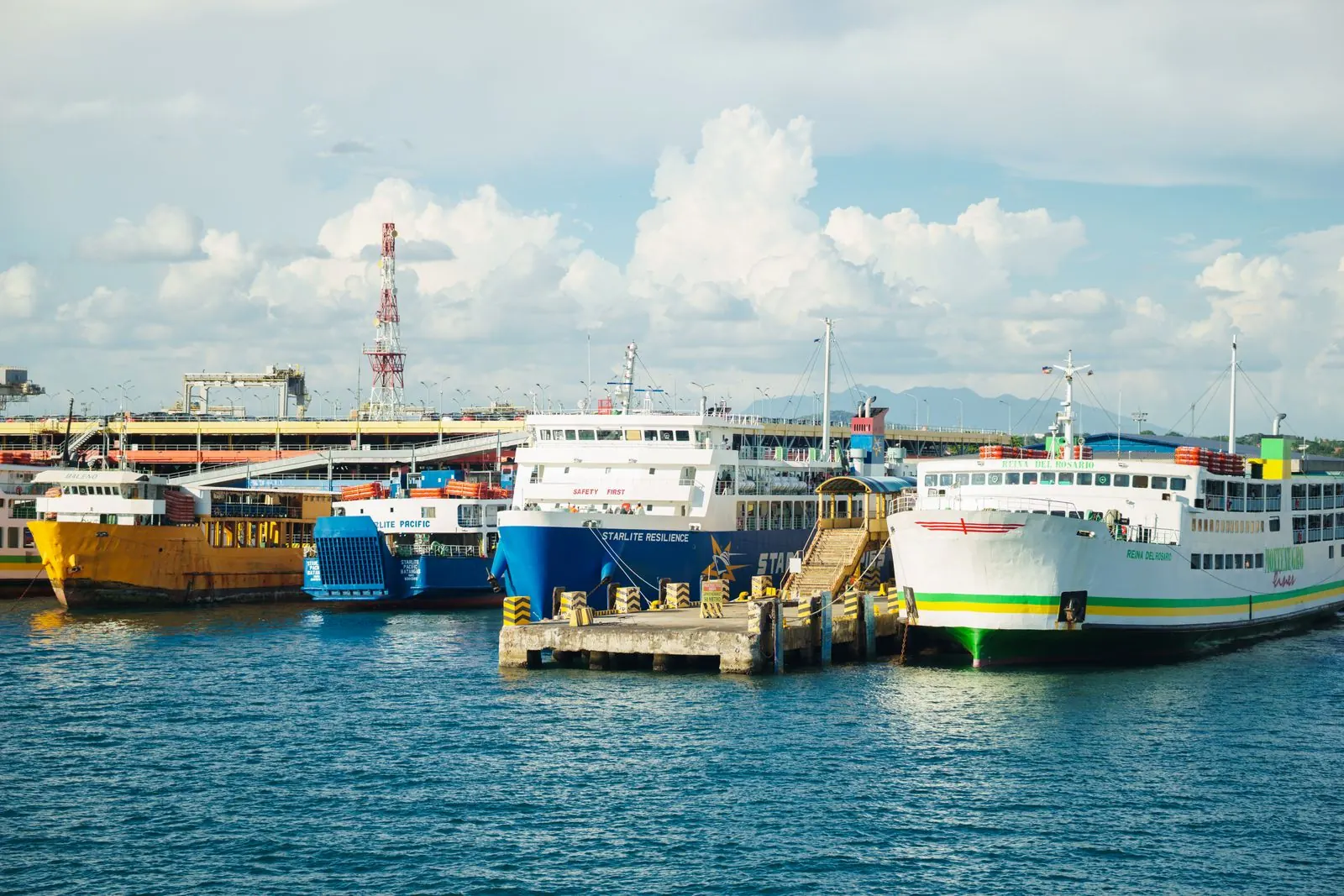
Leaving Siargao — the departure day, by air and by sea
Arriving on this island is flexible. Leaving it is not — the airport’s bottleneck is the departure side, the sea exit can be closed by the coast guard with no notice, and neither of those is what most itineraries plan for.
The half of the trip nobody plans
Every guide to this island, including ours, spends its energy on getting here — which gateway, which season, which base. Almost none of them cover leaving, and leaving is the half that actually goes wrong. An arrival is elastic: if the flight is late or the boat is slow, you get to your room later and the holiday absorbs it. A departure is not. It runs to a clock somebody else set, it usually starts with a road transfer across an island where we publish no journey times because the honest ones vary, and it has a hard edge — a closed check-in counter, a sailing that was suspended at eight in the morning — that costs real money to get wrong. This page is about that day: what constrains it at each of the island’s two exits, and what we need from you to have a vehicle in the right place at the right hour.
Sayak is a domestic airport, so leaving the country is never one flight
This is the single most useful fact about flying out of Siargao and it catches people every season. Sayak Airport (IATA: IAO), in the municipality of Del Carmen, is classified by the Civil Aviation Authority of the Philippines as a Class 2 principal airport — a minor domestic one. There are no international departures from this island. If you are flying home, your Siargao flight is a domestic hop to a hub, and the flight that actually leaves the Philippines is a separate one you connect to afterwards. That has two consequences worth planning around. The first is that a same-day connection to a long-haul departure is the arrangement most likely to fail, because a delay on the island leg has nowhere to go. The second is that if the two legs are on separate tickets, nobody is responsible for the connection but you — a missed onward flight is not rebooked for free. The runway takes turboprop aircraft rather than jets, which is the constraint behind the island’s short daily schedule; we do not publish the runway length, because the published sources disagree with each other.
The bottleneck at Sayak is the departure side, not arrivals
Visitors reasonably assume that a small airport is quick to leave from, and at Sayak the opposite has been true. When the Department of Transportation inspected the airport in March 2025 it was handling seventeen flights a day through a terminal designed for fewer than 200 passengers with three check-in counters, and it was specifically the pre-departure area that was described as cramped and overcrowded. Ground was broken on 8 August 2025 on a new passenger terminal building intended to take pre-departure seating capacity from 200 to 750 and add six more check-in counters, on a modular design its backers said could be completed in about eight months, ahead of the Philippines hosting the ASEAN Summit in 2026. What we will not do is guess which terminal you meet on your date. We time a departure pickup for the smaller one, because being early at a bigger terminal costs you an hour of waiting and being late at the smaller one costs you the flight.
Send us the flight, not a pickup hour
The counter cut-off is the number that actually governs your morning, and it is published by the airline rather than guessed by us. Cebu Pacific’s own domestic guidance is that airport check-in counters close 45 minutes before departure, that passengers should be at the airport two hours before the flight, and that online check-in is open from 48 hours before departure until an hour before it. Work backwards from the counter closing rather than from the departure time and the picture changes: the deadline that matters has already passed while the aircraft is still on the ground. So the most useful thing you can put in a departure request is the flight number and date. We work the pickup back from it — through the check-in cut-off, the terminal you are likely to meet, and the road leg from wherever you are staying — instead of you picking an hour that feels early enough. If your carrier is not Cebu Pacific, tell us that too; the cut-offs are published per airline and we will use yours.
The sea exit can close with no notice — and not only in typhoon season
The ferry from Dapa Port to Surigao City is the island’s other way out, and it carries a risk the airport does not: it can be stopped entirely, at a few hours’ notice, by the Philippine Coast Guard. This is a routine administrative act, not a rare emergency. On the morning of Saturday 14 March 2026 the Coast Guard Station Surigao del Norte suspended travel for sea vessels and watercraft of 250 gross tonnage and below across Surigao del Norte, Dinagat Islands and the Siargao Islands, citing strong to gale-force winds on the eastern seaboards of Visayas and Mindanao from the northeast monsoon and a PAGASA forecast of wave heights of 2.8 to 4.5 metres; the same advisory was issued by the coast guard station on Siargao itself. The instrument behind it is Memorandum Circular No. 03-01 of 2 February 2001, which sets out how vessel movements are handled where there is no local weather bulletin. Note the date on that one. March is not typhoon season — it was the amihan, the northeast monsoon, which our seasonality guide explains falls on the eastern side of the country, where Siargao is. Suspensions have also followed the habagat in September 2024, Tropical Depression Kristine in October 2024, Typhoon Opong in September 2025 and Typhoon Inday in July 2026. There is no month in which the sea exit is guaranteed.
Which boat stops first, and why we publish no sailing times
The suspensions above are scoped by tonnage rather than applied to everything afloat, and that detail decides whose crossing is cancelled. The March 2026 advisory covered vessels of 250 gross tons and below; a July 2026 one during Typhoon Inday was reported as covering watercraft of 35 gross tons and below. The practical reading is that the small fast craft — the quick, popular crossing — is the first thing to stop, while a larger roll-on/roll-off ferry may still sail, and the threshold moves from advisory to advisory. We deliberately publish no sailing times, no crossing durations and no operator timetable anywhere on this site, because the widely republished Dapa–Surigao schedules contradict one another and even the lists of which companies are currently running the route disagree between sources. Check the day’s sailings with the port on the morning you travel, and treat a boat exit before a same-day flight out of Surigao or Butuan as the plan that needs a spare day behind it.
Where you stayed decides how early the road leg starts
Both exits are on the west side of the island and most visitors stay on the south-east coast, so a departure day almost always opens with a cross-island drive. How long that leg is depends entirely on your base, and the difference between bases is large: General Luna sits a straightforward road transfer from either gateway, while Pacifico, Burgos and Santa Monica at the north end are the island’s longest road move and the one where a departure deadline bites hardest. We have a route page for each of those departures — General Luna to Sayak and to Dapa, and the north end to both — and none of them publishes a journey time, for the same reason nothing else here does: weather, road works and the exact pickup address change it. What is safe to plan around is the ordering. Fix the flight or the sailing first, then the pickup, then how late you can reasonably be out the night before. On this island that last one is a real constraint, not a joke.
What to send us for a departure transfer
Tell us the date, where we are collecting you from, and which exit you are using. If you are flying, send the flight number and its scheduled departure time and we will work the pickup back from the counter cut-off rather than from the take-off. If you are sailing, tell us the sailing you intend to catch and we will build in the margin the port queue needs. Add your group size, your bags, any surfboards, and whether you need help loading — those change the vehicle rather than being an afterthought at the kerb. We will come back with one fixed, all-in price by email, with no deposit to ask and no obligation to book. And if the coast guard closes the sea on your morning, or your flight moves, tell us: rearranging a transfer you already hold is far easier than finding a vehicle at short notice on the day everyone else is trying to leave too.
No published price — and that is deliberate
A fair price depends on your date, your group, your bags and how long we wait. So we quote per trip instead of publishing a number we would have to hedge. Fill in the form below and we will send a fixed, all-in price by email.
Tell us your trip. Get a fixed price.
It takes under a minute. No account, no payment now, no obligation — just a clear, all-in quote from someone who actually drives these roads.
- Free & no-obligation — quote first, decide later
- Reply by email from a real person on the island
- Fixed, all-in pricing for the right-sized vehicle
- Your details are used only to prepare your quote