
Siargao with young children — what the law says, and what actually works
The island’s two default vehicles are a motorcycle and a tricycle, and Philippine law puts both outside the child car seat rules entirely. Here is what that means for a family arrival, and what to ask for instead.
The two vehicles you will be offered — and the rule that does not reach them
Get off a flight at Sayak or a ferry at Dapa with a small child and the transport waiting outside is, overwhelmingly, a habal-habal (a motorcycle carrying passengers) or a tricycle. Both are a normal, useful part of getting around Siargao, and our own guide to getting around the island says as much. For a family with a toddler, though, there is a specific thing worth knowing before you are standing in the arrivals area deciding: the Philippine child car seat law does not apply to either of them. Republic Act No. 11229, the Child Safety in Motor Vehicles Act, defines the vehicles it governs in Section 3 and then says so in as many words — “The term shall not include the tricycle and motorcycle.” That is not a loophole somebody found; it is the statute’s own scope. So the reassurance of “it must be legal, everyone does it” does not mean what it sounds like it means. Nothing in the child restraint law was ever written to cover the two vehicles you are most likely to be offered.
What the motorcycle law does say — and the test worth using
Motorcycles carrying children are governed by a different statute, Republic Act No. 10666, the Children’s Safety on Motorcycles Act of 2015. It is worth reading carefully rather than through the summaries, because the widely repeated line that “children are banned from riding motorcycles in the Philippines” overstates it. The prohibition in Section 4 is scoped to public roads where there is a heavy volume of vehicles, a high density of fast-moving vehicles, or a posted speed limit above 60 kph — conditions that describe a city artery far better than most of Siargao. What is genuinely useful anywhere is the test the same section sets out. A child may ride only if all three of these hold: the child can comfortably reach the standard foot pegs, the child’s arms can reach around and grasp the rider’s waist, and the child is wearing a standard protective helmet under RA 10054, the Motorcycle Helmet Act of 2009. Those three conditions are a plain physical standard, and a small child fails all three. Penalties, for the rider, run to ₱3,000 for a first offence, ₱5,000 for a second and ₱10,000 thereafter, with the driver’s licence suspended for a month at the third. The Act makes one exception, for a child needing immediate medical attention.
What a child restraint system legally means here
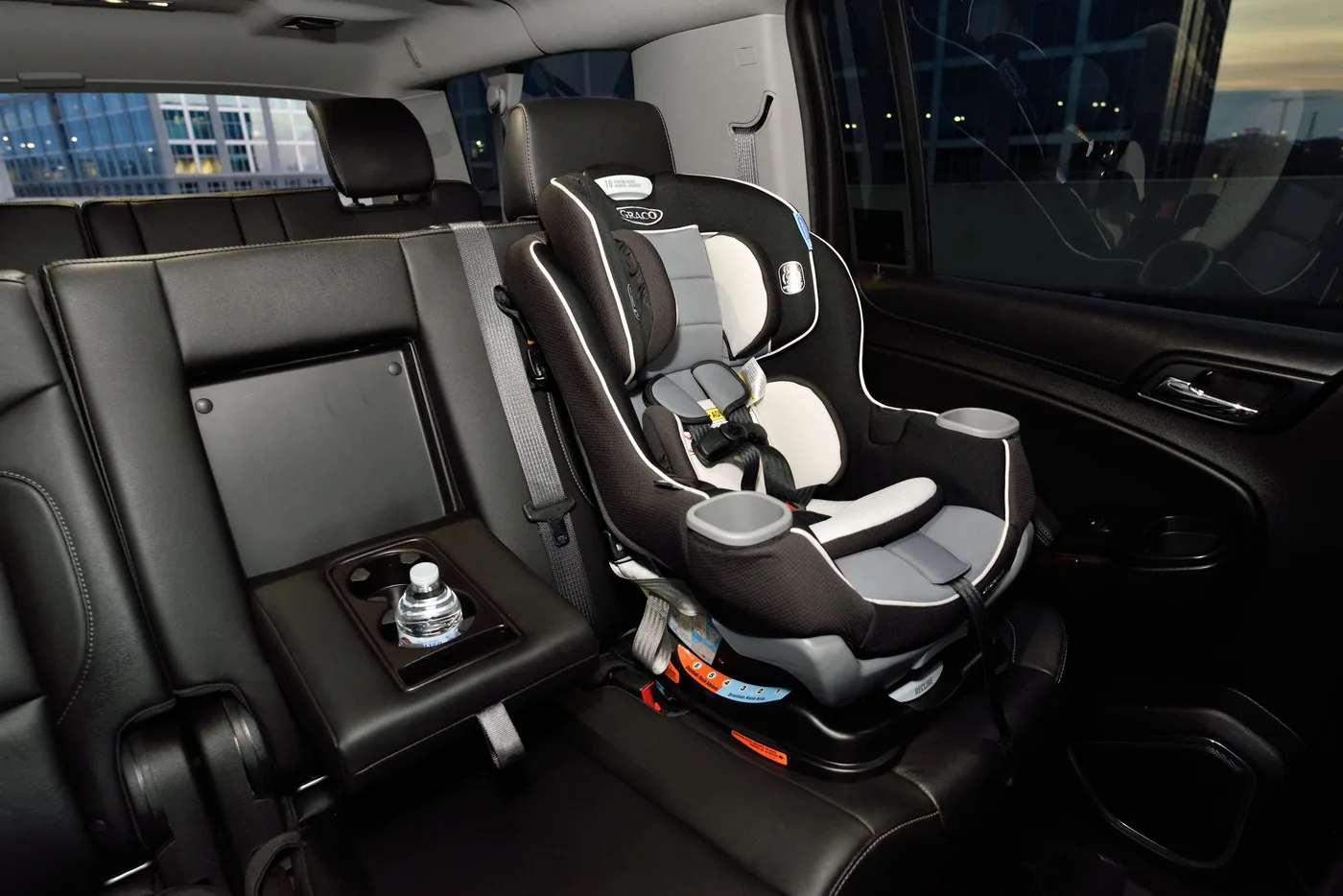
For vehicles that RA 11229 does cover, the standard is precise and it is set by height rather than by age alone. A child — defined in the Act as anyone twelve years old and below — must be properly secured in an age-, height- and weight-appropriate child restraint system, unless the child is at least 150 centimetres (59 inches) tall, in which case the regular seat belt is the requirement instead. Section 5 adds the rule that is most often forgotten on a holiday: no child of twelve or below travels in the front seat at all unless they meet that same 150 cm height threshold and are belted in. The Act also states that a child is never to be left unaccompanied by an adult in a vehicle, even when correctly restrained, and it sets exceptions only for medical emergencies, a child with a medical or developmental condition, and analogous circumstances defined in the implementing rules. Approved seats are those meeting United Nations Regulation 44 or Regulation 129, and a seat sold legally in the Philippines carries a Philippine Standards (PS) mark or an Import Clearance Certificate from the Bureau of Product Standards — which is the thing to look for if you plan to buy one here rather than bring your own.
The honest bit: where hired vehicles sit in that law
We are not going to tell you the law obliges every vehicle you can hire on this island to carry a child seat, because that is not what it says, and a family planning a trip deserves the actual position. RA 11229 defines a “covered vehicle” as a private motor vehicle, or a public motor vehicle upon determination by the Department of Transportation. Section 9 then directs the DOTr to study child restraint use in public utility vehicles — jeepneys, buses, school buses, taxis, vans, coasters and the rest — and to recommend to Congress either their inclusion or other safety measures. Section 15 further provides that mandatory compliance is enforced only one year after the implementing rules take effect. So the mandate is written squarely around private motor vehicles, and Congress deliberately routed the for-hire category through a study rather than settling it in the statute. What none of that changes is the physics of a car journey with a fifteen-kilogram passenger, or the fact that a seat you asked for in advance is the only kind that is going to be there.
Why an island arrival is where this bites
Sayak Airport is in the municipality of Del Carmen, on the west side of the island — not in General Luna, where most visitors actually stay, on the south-east coast. Arriving by sea puts you at Dapa, also on the west side. Either way, a family arrival ends with a road transfer across the island rather than a short hop, and the municipalities involved are large: measured from the 2023 PSGC boundaries, Del Carmen covers roughly 148 square kilometres and Dapa about 84, against General Luna’s 47. We publish no journey times anywhere on this site, because honest ones vary with the weather, the road works and exactly where you are staying. But the shape of the thing is the point: this is a proper drive at the end of a travel day, usually with luggage, sometimes in the dark, and often in rain — Surigao del Norte is climate type II, with no dry season at all and its heaviest rainfall from November to January. That is a very different proposition from splitting a family across two tricycles at the kerb because it is what was there.
What to put in the request
The quote form below has a checkbox for a child seat, and asking for it is the whole mechanism — it is quoted in, not added as a surprise later. Tell us the ages and rough heights of the children travelling, because the 150 cm line above is what decides whether a child needs a restraint or a seat belt, and it changes what we send. Add your group size, your bags, any pushchair or travel cot, and whether you would like a hand loading and unloading. If you are arriving, send the flight number and date or the ferry sailing, so the vehicle is there when you actually land rather than when the timetable said you would. We will come back with one fixed, all-in price by email, with no deposit to ask and no obligation to book — and if there is something we cannot do for your trip, we will say so in writing before you commit, rather than on the morning.
No published price — and that is deliberate
A fair price depends on your date, your group, your bags and how long we wait. So we quote per trip instead of publishing a number we would have to hedge. Fill in the form below and we will send a fixed, all-in price by email.
Tell us your trip. Get a fixed price.
It takes under a minute. No account, no payment now, no obligation — just a clear, all-in quote from someone who actually drives these roads.
- Free & no-obligation — quote first, decide later
- Reply by email from a real person on the island
- Fixed, all-in pricing for the right-sized vehicle
- Your details are used only to prepare your quote